
2.4610 N06455 Forged Rings
- PRODUCT DETAIL
2.4610 N06455 Forged Rings
2.4610 N06455 Forged Rings and Forged Components
1. Technical Summary
2.4610 N06455 forged rings are supplied for engineered applications requiring controlled material integrity, stable manufacturing processes and full traceability. These forged components are produced under defined process conditions including forging, heat treatment and inspection to ensure compliance with project-specific requirements. The purpose of this page is to present the technical basis for supply, including manufacturing control, inspection practices and documentation structure, to support EPC procurement evaluation and vendor qualification.
2. Product Scope
The supply scope of 2.4610 N06455 forged rings includes ring forgings as the primary product, together with forged discs, hollows, sleeves and flange forgings when required. Products may be delivered in as-forged or pre-machined condition depending on dimensional tolerances and downstream machining requirements. Production supports multi-size and small batch quantities typical of project procurement, where different dimensions are required under controlled material conditions.
3. Project Reference (Delivered 2.4610 N06455 Forged Rings)
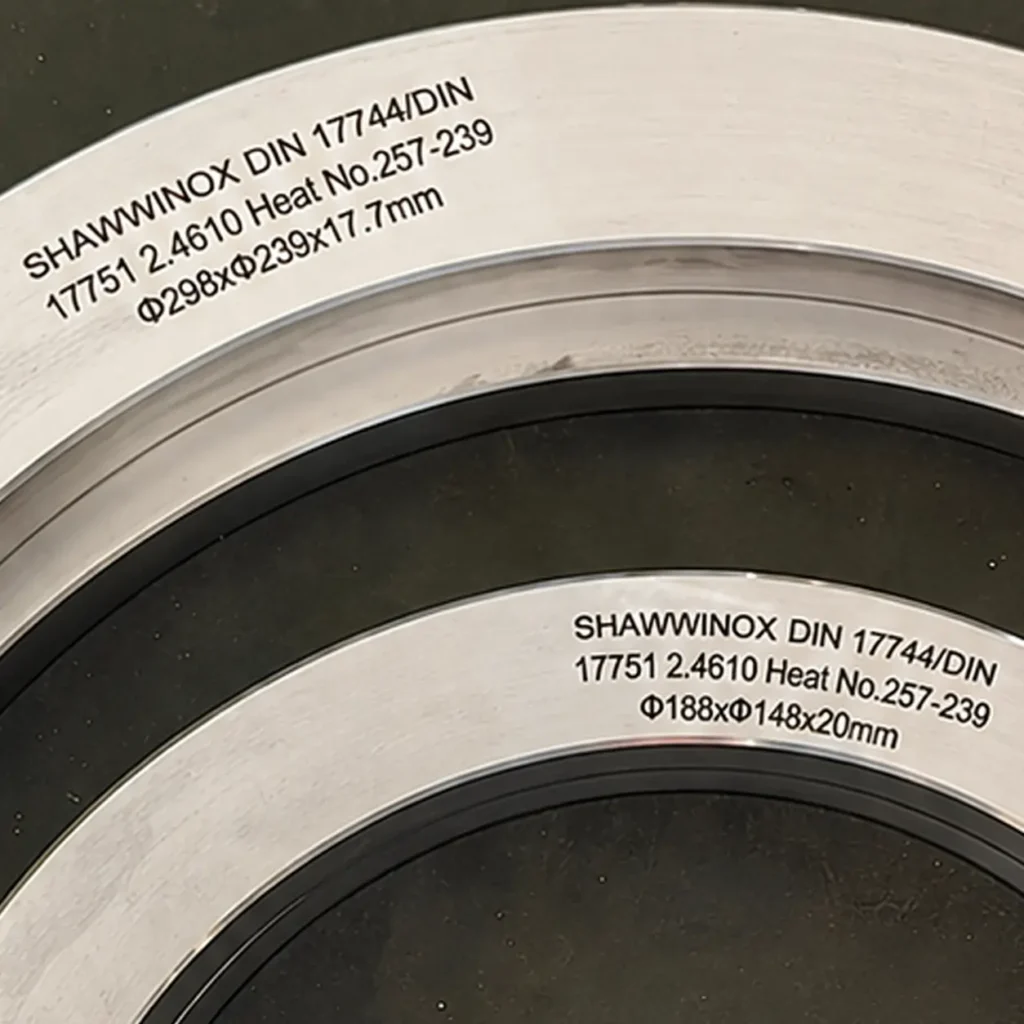
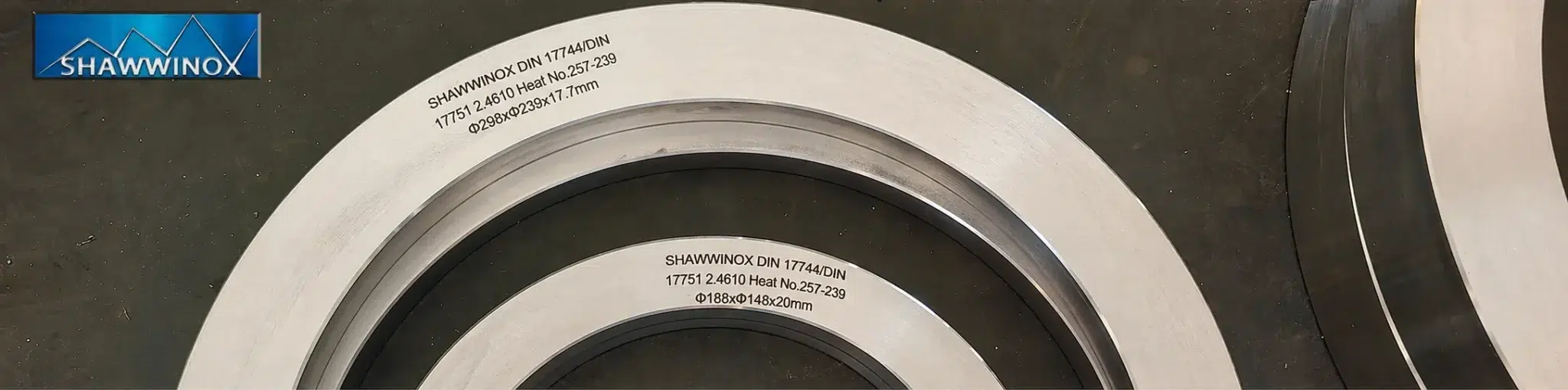
Delivered 2.4610 N06455 forged rings have been supplied in multiple sizes under the same heat number, ensuring consistency of chemical composition and mechanical properties across the batch. Inspection records indicate acceptance of penetrant testing (PT) and ultrasonic testing (UT), confirming internal and surface quality. Mechanical properties and chemical composition are documented in inspection certificates, demonstrating stable production capability and repeatability under controlled manufacturing conditions.

4. Material & Standards
2.4610 N06455 forged rings are supplied in accordance with DIN / Werkstoff material designation, with reference to equivalent international systems where applicable. Material identity is maintained consistently across purchase order, product marking and inspection documentation. Applicable standards are combined with project-specific specifications, ensuring alignment between material requirements, manufacturing execution and final documentation.
5. Manufacturing & Heat Treatment
Manufacturing of 2.4610 N06455 forged rings is controlled through a defined forging route including raw material verification, heating control and deformation management. Forging parameters are selected to achieve adequate reduction and structural integrity, minimizing internal defects and ensuring uniformity. Heat treatment is applied following forging to achieve the required metallurgical condition. Control of temperature and holding time ensures that the final microstructure and mechanical properties meet project requirements.
6. Inspection & Testing
Inspection and testing of 2.4610 N06455 forged rings are performed in accordance with inspection and test plan requirements. Inspection stages include incoming verification, in-process monitoring and final inspection. Testing activities include dimensional inspection, mechanical testing and non-destructive examination such as PT and UT where specified. These inspections confirm compliance with technical specifications and provide verification of product integrity prior to delivery.
7. Traceability & Documentation
Full traceability is maintained for 2.4610 N06455 forged rings through heat number control, lot identification and marking systems. Each product can be traced back to its original material batch and manufacturing process. Documentation includes inspection certificates, test records and traceability reports, supporting third-party inspection and project documentation requirements. This structure ensures transparency and consistency during procurement review and project execution.
8. Dimensions & Delivery Condition
2.4610 N06455 forged rings are supplied with controlled outer diameter, inner diameter and thickness, based on drawing or specified tolerances. Machining allowance is provided where required to support final machining operations. Delivery condition may be as-forged or pre-machined, depending on project requirements. Dimensional control ensures compatibility with downstream equipment assembly and machining processes.
9. Typical Applications
2.4610 N06455 forged rings are used in engineered systems where corrosion-resistant alloy components are required. Typical applications include process equipment components, sealing interfaces, connection parts and custom forged elements manufactured according to project drawings. These components are used in environments where material performance and reliability are critical.
10. RFQ Information Needed
For accurate quotation and technical evaluation of 2.4610 N06455 forged rings, it is necessary to provide product drawings or dimensional specifications, quantity per size, delivery condition, inspection requirements, documentation level and applicable project standards. This information allows alignment between procurement requirements and manufacturing capability, ensuring that supplied products meet project expectations.