
Engineered alloy materials project quality documentation
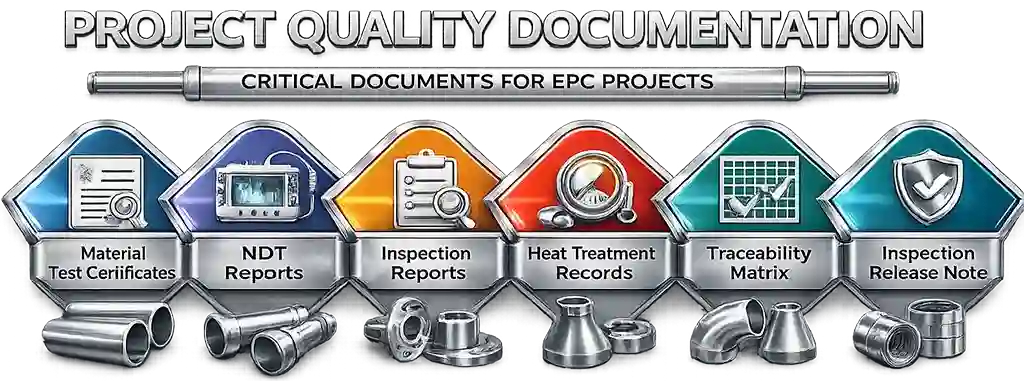
Engineered alloy materials project quality documentation is an essential part of project material supply for EPC projects, industrial plants, offshore facilities, LNG projects and power plants. Engineered alloy materials project quality documentation ensures that all materials supplied are fully traceable, inspected, tested and compliant with project specifications, international standards and purchase order requirements.
Engineered alloy materials project quality documentation includes material test certificates, inspection reports, non-destructive testing reports, heat treatment records, dimensional inspection reports, traceability records, packing lists and final project documentation packages. These documents are required for project material acceptance, installation and final project documentation submission.
Material Test Certificates and Material Compliance Documentation
Material test certificates are the core documents in engineered alloy materials project quality documentation. Material test certificates are typically issued in accordance with EN 10204 3.1 or EN 10204 3.2 depending on project requirements. Material test certificates include chemical composition, mechanical properties, heat treatment condition, heat number and reference standards.
For stainless steel, duplex stainless steel, super duplex stainless steel and nickel alloys, material test certificates confirm compliance with ASTM, ASME, EN or other project standards. Material test certificates must be traceable to heat numbers marked on materials.
Material compliance documentation ensures that materials supplied meet project specifications and material standards.
Inspection Reports and Dimensional Inspection Records
Inspection reports are part of engineered alloy materials project quality documentation and confirm that materials comply with dimensional requirements, visual inspection requirements and surface condition requirements. Inspection reports may include dimensional inspection reports, visual inspection reports and surface condition inspection reports.
Dimensional inspection reports confirm pipe diameter, wall thickness, length, flange dimensions, fitting dimensions and forging dimensions in accordance with applicable standards such as ASME B36.19, ASME B16.5 or EN standards. Inspection reports are important documents for project material acceptance.
Non-Destructive Testing Reports
Non-destructive testing reports are included in engineered alloy materials project quality documentation for materials requiring additional inspection such as welded pipes, forgings or critical piping components. Non-destructive testing may include ultrasonic testing, radiographic testing, liquid penetrant testing, magnetic particle testing and eddy current testing.
Non-destructive testing reports confirm the absence of internal defects, weld defects or surface defects. NDT reports must reference applicable standards, acceptance criteria and inspection procedures.
Non-destructive testing documentation is often required for pressure piping, offshore piping and critical service materials.
Heat Treatment and Manufacturing Records
Heat treatment records and manufacturing records are important parts of engineered alloy materials project quality documentation, especially for duplex stainless steel, super duplex stainless steel and nickel alloys where heat treatment parameters significantly affect material properties.
Heat treatment records may include solution annealing temperature, holding time, cooling method and furnace records. Manufacturing records may include forming records, welding procedure records and production process records.
These records demonstrate that materials were manufactured in accordance with approved procedures and project specifications.
Material Traceability Documentation
Material traceability documentation links material test certificates, inspection reports, NDT reports and marking information to individual materials or batches. Traceability documentation ensures that each pipe, fitting, flange or forging can be traced back to its heat number and material test certificate.
Material traceability is a key part of engineered alloy materials project quality documentation and is required by most EPC projects and industrial projects to ensure quality control and material compliance.
Traceability documentation typically includes traceability matrix, heat number list, inspection report references and marking records.
Packing List and Shipping Documentation
Packing lists and shipping documentation are also part of engineered alloy materials project quality documentation. Packing lists identify each item shipped, including material grade, size, quantity, heat number and package number.
Shipping documentation may include packing list, commercial invoice, bill of lading and shipping marks. Packing lists must match materials delivered and must correspond with material test certificates and inspection reports.
Proper shipping documentation ensures that materials can be received, inspected and installed without documentation issues.
For project material supply experience, refer to the Project Reference page. For overall quality control procedures, refer to the QA/QC page. The materials described in these procedures are part of the Engineered Alloy Materials supply scope for industrial and EPC projects.
Final Project Documentation Package
Final project documentation packages are compiled after material production, inspection, testing and shipment are completed. Final documentation packages may include material test certificates, inspection reports, non-destructive testing reports, heat treatment records, traceability documents, packing lists and shipping documents.
Final documentation packages are submitted to clients as part of project material documentation and are often required for project completion documentation and final acceptance.
Final documentation packages are the final stage of engineered alloy materials project quality documentation and demonstrate that materials supplied comply with project requirements and quality control procedures.